
What Drives Timber Frame Home Cost
Almost every first phone call we get comes around to the same question sooner or later. What does a timber frame home cost? Bruce has been answering it since 1979, and his answer hasn’t changed much. It depends on the frame, and no two frames are the same.
We don’t put a number on the website because it wouldn’t mean much for your project. What we can do is walk you through what makes a frame take more or less time and material in our shop.
What the Frame Covers
A lot of confusion starts right here. The frame is the posts, beams, braces and rafters. We work out the design with you and your designer or architect, cut the frame by hand in Alstead, and raise it on your site.
The foundation, plumbing, electrical, interior finishes and general contracting are done by others on your team. When you compare proposals, ask each builder to put in writing what’s in and what’s out.
Corners and Valleys
A bigger building takes more wood and more joints. That part is easy to see. What folks don’t always expect is that a plain rectangle with a simple roof can cost less than a smaller house with lots of dormers, hips and valleys.
Every place two roof planes meet means careful layout and some tricky cuts. On The Andover, the hardest part of the whole job was a pair of valley rafters. Each one had a long string of compound miter cuts. They started on cantilevered plates and ended on a purlin, and they had to wrap above and below that purlin to make a solid connection. It took a lot of hours at the layout table before anyone picked up a saw.
So when you sketch your plan, look at each bump-out and extra gable. If it makes you smile every time you pull in the driveway, keep it. If it’s there because you saw it in a magazine, it might be worth a second look.
Picking the Wood
We cut eastern white pine, Douglas fir, hemlock and oak, all from sustainably managed forests. The softwoods are more common these days and easier to work. Oak is harder to come by and slower going under the chisel, but it makes a beautiful frame.
Size matters too. A long span with no posts in the middle needs bigger timbers, and big timbers are harder to find and heavier to move around the shop. Our post on choosing your timber has more.
How Much Frame You Want to See
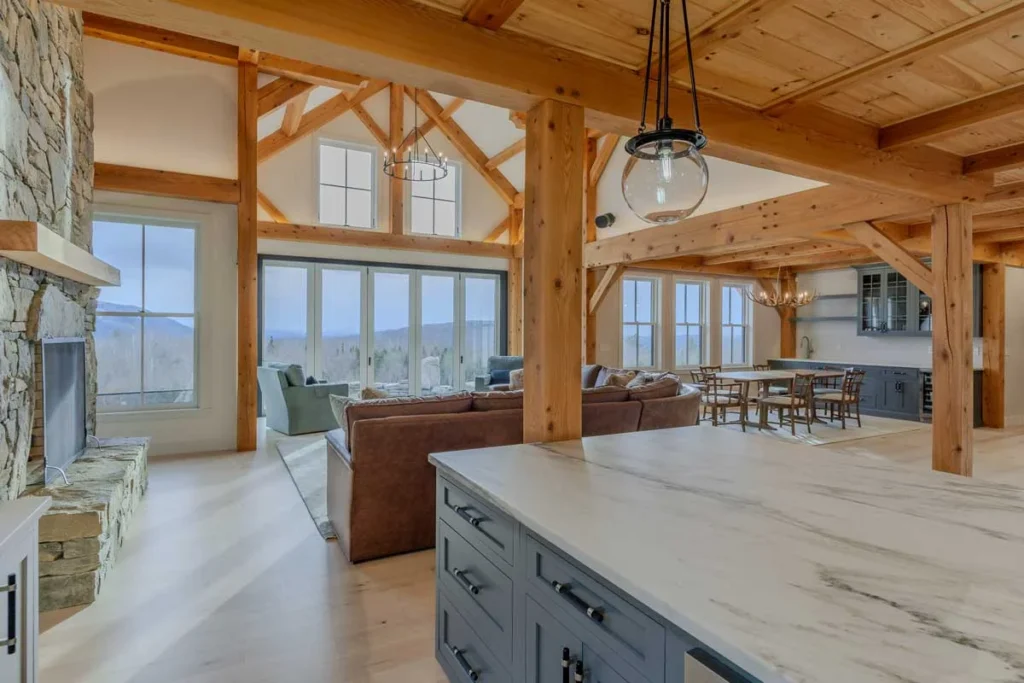
Plenty of folks don’t realize they don’t have to build the whole house out of timber. A lot of our clients put the frame where they’ll see it most, like the great room or the kitchen, and build the bedrooms and baths with regular framing. You still get that moment at the front door without paying for beams hidden behind a closet wall.
The Details That Take Time
Every frame we cut uses mortise and tenon joints held with oak pegs. That’s how we always do it, so it isn’t an add-on. But some details within that take longer, like curved braces, scroll-end plates, hand-hewn surfaces and fancy trusses.
The curved braces on The Sequoyah are a good example. We went looking for trees with a natural bend, slabbed them right there in the woods with an Alaskan chainsaw mill, and carried the slabs out one at a time. The client called them “whale tails.” A straight brace would have been a lot quicker.
The Rest of the Budget
When a budget falls apart, the frame usually isn’t the cause. It’s the other line items people didn’t plan for. A steep, wooded lot with a long driveway needs more site work than an open field. The foundation depends on your soil and frost depth. Many frames get wrapped in SIPs, and those panels need a crew to put them up. Then there’s shipping, a crane, permits, and cabinets and flooring.
We usually suggest writing all of it down on one sheet of paper before you settle on a floor plan.
Who Cuts It
We’re a small family shop. When you call, you talk to the people who will cut and raise your frame. There’s no sales team and no showroom to pay for, and that helps keep our pricing fair.
Loren found that out after he lost his house to a fire in March 2018. Other timber frame companies came in out of his budget, but Bruce gave him a ballpark that worked. His frame was cut 1,700 miles from the site and went together “without one miss cut beam.” He called it his best building experience, and we were glad to be part of it.
If you want to talk through what your own frame might take, give us a call at (603) 309-8793 or send us a note and we’ll sit down and go over it with you.


