
Timber Frame vs Post and Beam: How the Joints Differ
People ask us fairly often whether timber frame and post and beam are the same thing. It’s a fair question. Both use big posts and beams spaced far apart, and in a photo the two can look almost alike. The difference is in how the pieces are held together, and that’s something you can’t always see from across the room.
Wood Joined to Wood
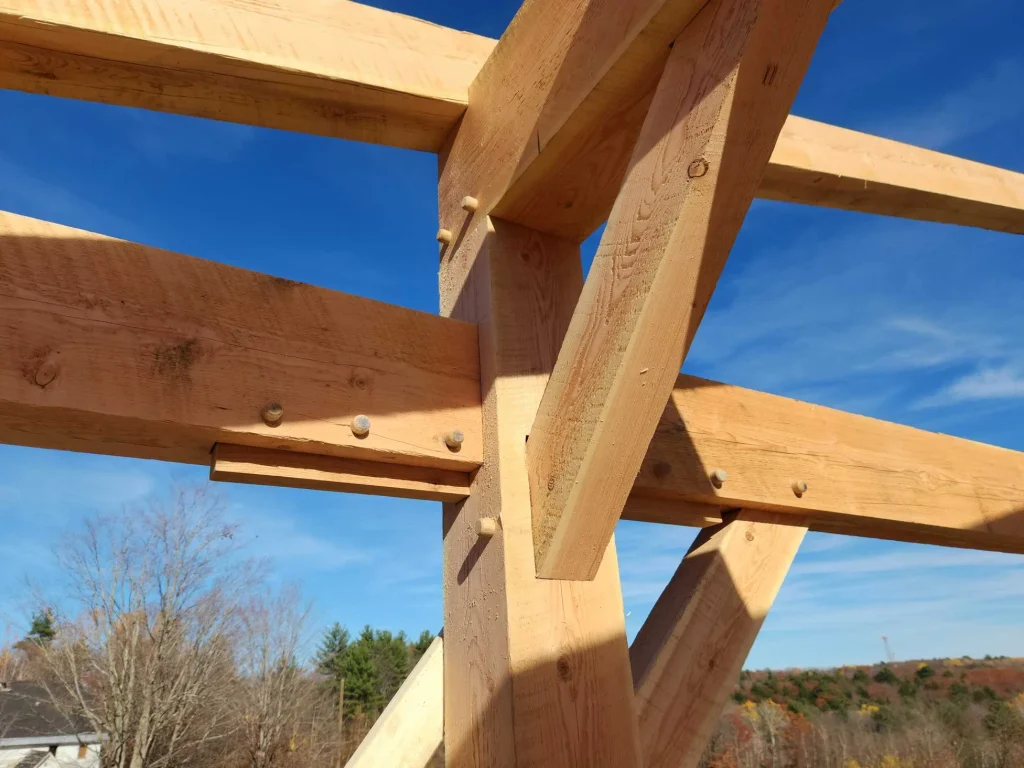
In a timber frame, the wood does the joining. One timber gets a tenon cut on the end, which is a sort of tongue. The timber it meets gets a mortise, a pocket chopped out to take that tenon. Once the two are together, we drill through the joint and drive in an oak peg. The pieces stay put because of the shape we cut into them.
Post and beam usually works another way. The timbers are often cut square on the ends and fastened with steel plates, brackets, bolts or lag screws. The wood still carries the weight, but the metal holds the joints together.
Every frame we cut is mortise and tenon with oak pegs. There are no nails or metal plates holding the joinery. That’s how Bruce learned it and how he has done it since 1979.
What Happens in the Shop
Cutting a mortise and tenon frame is slow, careful work. Each joint gets laid out on the timber by hand. Then it gets cut with saws, drills and chisels, and pared until the shoulders sit flat and the tenon slides in snug. A knee brace has to meet the post and the beam at just the right angle, or the bent won’t come together square on site.
When it’s right, you can hear it. Dale and Rick had a design with several gables tying into one ridgeline. They told us that on raising day, the timbers locked in place “with an interesting locking sound.” That’s wood seating into wood right where it was cut to go.
If you want to see what the joints look like in finished homes, take a few minutes in our gallery. Look at where the braces meet the posts and you’ll spot the pegs.
Why the Joint Matters
To be fair to the other side, a well engineered post and beam building with steel connectors can stand a long time. It isn’t a bad way to build. But you should know what you’re getting.
Big timbers keep drying for years after they go up, and they swell and shrink a little with the seasons. A wood joint tends to move along with the wood around it. Steel doesn’t shrink with the timber, so a bolted joint can loosen up as things dry, and some may need tightening down the road. If you’re talking with a post and beam builder, ask how they deal with that.
Looks are the other part of it. A peg sits flush and blends into the grain. Steel plates and bolt heads stay in view unless someone takes the time to hide them. Some modern houses show off blackened steel on purpose, and that’s a fine choice if it’s the look you want.
Why Some Builders Use Metal
Mostly it’s speed. Square cuts and bolted plates take less layout and less handwork, so a crew can turn out more buildings in a season.
The trouble comes when a company calls its work “timber frame” because the timbers are big, while the joints are steel. You see nice photos, you see the words you searched for, and you figure you know what you’re buying. Then the bolts show up on raising day. It’s worth asking plainly before you sign anything.
A Few Questions to Ask
Whoever you talk to, including us, ask how the main joints are connected. You’re listening for “mortise and tenon with wooden pegs,” or else words like plates and bolts. Ask whether any hidden metal is used in the joinery, since you won’t see it in a picture. Ask who cuts the joints and where. And ask how the design handles the wood drying out over time.
It’s also fair to ask to talk with past clients. We’re happy to put you in touch with folks we’ve built for.
Price is a separate conversation, and it depends a lot on who you buy from. We’re a small family shop with no sales staff, which helps us keep things fair. If you want more on that, our post on what drives the cost of a timber frame home covers it.
Pegs or Bolts
In the end it often comes down to a simple picture. Stand in your future great room and look up. Would you rather see wooden pegs or bolt heads? Most people know their answer right away.
If you’d like to talk joinery with the folks who cut it, give us a call at (603) 309-8793 or drop us a line, and we’ll walk you through how your frame would go together.


