
Mortise and Tenon Joinery: Why Pegged Timber Joints Last
Bruce has been cutting mortise and tenon joints since 1979. Drive around New England and you’ll find old barns held together with nothing but wooden pegs, standing a lot longer than any of us. We still build every frame that way.
What the Joint Is
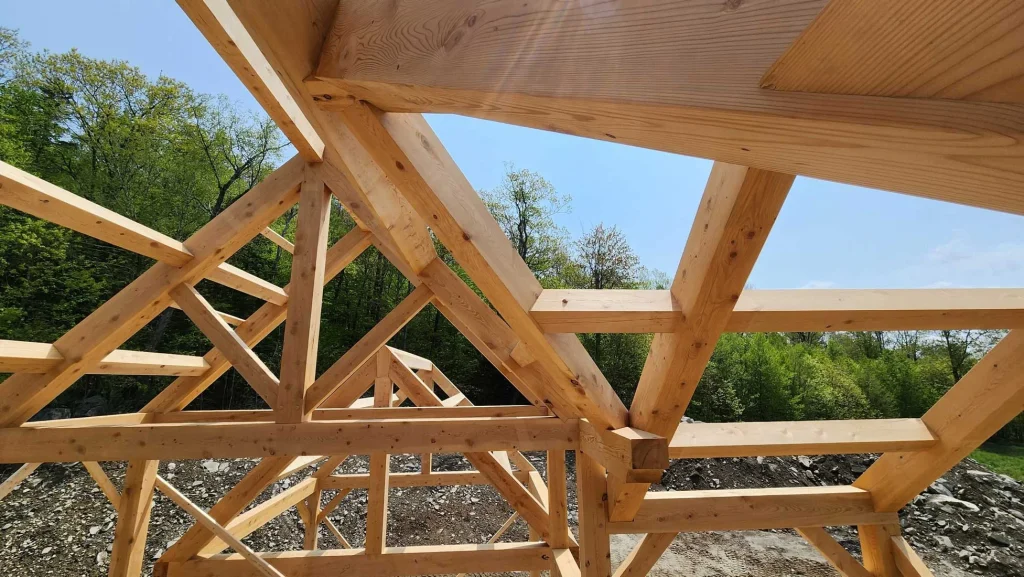
It’s a simple idea. A mortise is a square pocket cut into one timber. A tenon is a tongue cut on the end of another timber, sized to fit snug in that pocket. Slide the tenon in, bore a hole through both pieces, and drive a hardwood peg through to lock it.
That’s the basic version. A real frame uses lots of variations on it. There are housed joints, shouldered tenons, scarf joints for splicing two long timbers end to end, and the tricky compound angles where rafters meet a valley or a hip.
We cut ours by hand and pin them with oak pegs. There are no nails or metal plates holding the joinery together.
Why Wood Pegs and Not Steel
People are sometimes surprised that a wooden peg holds up better than a steel bolt in a frame like this. Part of it is that wood moves. Timbers shrink and swell a little with the seasons. A wooden peg moves right along with them, since it’s the same kind of stuff. Steel doesn’t, and over the years a rigid fastener can work loose in its hole or put a lot of stress on one small spot.
The other part is that the peg isn’t doing most of the work. The joint is. In a well-cut frame the shoulders of the tenon bear against the other timber, and the shape of the joint passes the weight along. The peg’s main job is keeping the joint closed.
There is also an old trick called draw boring. The hole through the tenon is bored just a hair off from the hole through the mortise. When the peg goes in, it pulls the tenon deeper and snugs the shoulders up tight. Dale and Rick, whose house had several gables on one ridgeline, said their timbers locked together “with an interesting locking sound.” That sound is a good day for us.
Timber Frame or Post and Beam
Plenty of buildings have big exposed beams that aren’t timber frames. In a lot of post and beam work, timbers are stacked or butted together and held with brackets, bolts or plates. That can be a fine way to build, but it is a different thing. If you’re comparing quotes, ask each company how their joints are connected. Our post on timber frame vs. post and beam goes into it more.
Joints That Took Some Figuring
Most joints in a frame are pretty routine once you have done a few thousand. Some are not. On The Andover, a ski house in Vermont, the hard part was a pair of valley rafters. Each one had a long list of compound miter cuts. They started on cantilevered plates and ended on a purlin, and they had to wrap above and below that purlin to make a good connection. There was a fair amount of head scratching at the layout bench on those. Three of us cut all the joinery for that frame in about a month and raised it in about another week.
On The Sequoyah, an oak frame, some of the knee braces came from trees with a natural curve. We slabbed them right in the woods with an Alaskan chainsaw mill and hauled them out one at a time. Fitting a curved brace takes patience, since nothing about it is square. The client took to calling the paired braces “whale tails,” which stuck.
Keeping Joints Dry
Pegged joints are plenty strong. What a joint doesn’t like is water sitting in it for a long time, especially in the end grain. That’s why we want the frame inside a dry, closed-in house. A lot of our frames get SIPs wrapped around the outside, so the timbers stay in view in the heated space. Outdoor frames need a little more help from good roof overhangs and post bases kept up off the ground.
As the timbers dry you may see small checks open up, sometimes near a joint. That’s normal for big wood, and we cover it in our post on checking and movement.
Seeing It for Yourself
You don’t need to know woodworking to spot good joinery. Look closely at where two timbers meet in a finished frame. Tight, clean shoulders with no gaps are a good sign. We are glad to put you in touch with past clients if you’d like to hear from them, and the gallery has plenty of close-ups.
If you’d like to hear how the joints in your own frame would be cut, get in touch or call (603) 309-8793. Bruce is always happy to talk joinery.


