
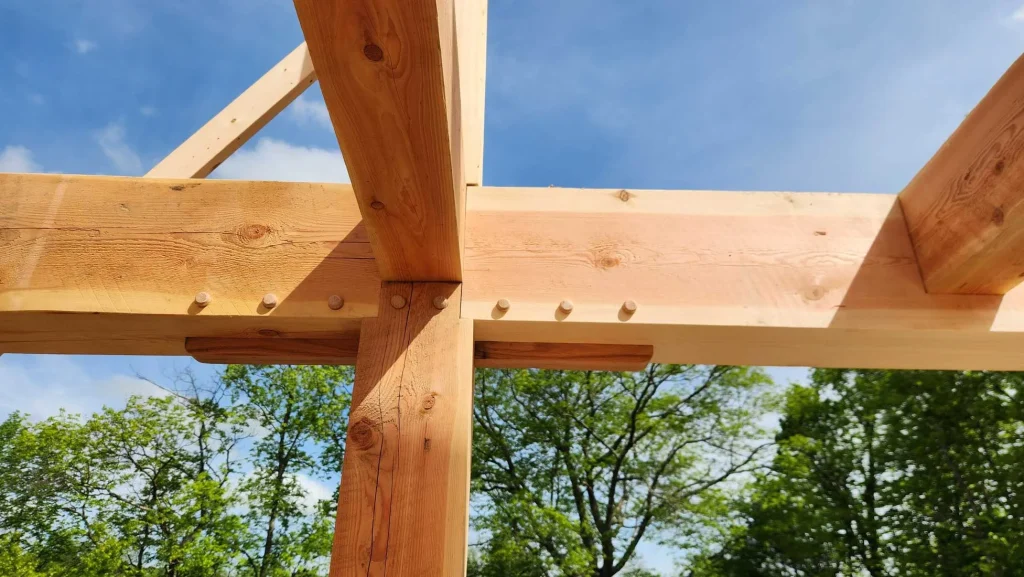
Timber Frame Checking: Cracks and Movement That Are Normal
It usually happens the first winter, once the heat comes on. You’re sitting in the new great room in the evening, you hear a sharp pop from up in the trusses, and the next morning there’s a crack running down the face of a beam that looked perfect on raising day. It’s natural to wonder if something’s wrong.
Almost always, nothing is. That crack has a name. It’s called a check, and it’s one of the most ordinary things a big timber does. Below we explain why it happens, and when it’s worth calling.
Why Big Timbers Crack
A tree is full of water when it’s cut, and a large timber takes a long time to dry all the way through. The outside dries faster than the middle. The outer wood wants to shrink, but the wetter core holds it back, and that tension opens up splits along the grain.
Those splits are checks. They run the long way, follow the grain, and are widest at the surface before narrowing as they go in. They tend to show up the first heating season, when the air inside the house gets a lot drier. That beam grew up in a damp forest, and now it lives a few feet from a wood stove.
Is It a Problem?
In most cases a seasoning check is a cosmetic thing, not a structural one. Heavy timbers are sized with plenty of wood in them, and a normal check along the face doesn’t take much away from what the beam can do.
The joinery helps too. In a pegged frame, the timbers work together as one connected structure. We cut every frame by hand with mortise and tenon joints and pin them with oak pegs, with no nails or metal plates holding the joints. More on that in our post on mortise and tenon joinery.
Different Woods, Different Habits
Every species dries and moves a little differently. We cut eastern white pine, Douglas fir, hemlock and oak, all from sustainably managed forests. The softwoods are more common now and easier to work. Oak is less common, and it has a bold grain that a lot of people love.
If you’re trying to choose, ask Bruce how the species you’re looking at tends to behave once it’s inside a heated house. Our post on picking the right wood covers the other trade-offs. If you’d like to see how oak looks after it’s settled in, the Sequoyah is an oak frame we finished with boiled linseed oil to bring out the grain.
Other Movement You Might Notice
Checks aren’t the only change in the first few years. Timbers shrink a little across their width as they dry, while their length hardly changes at all. That can make a joint look a touch less snug than it did the day we drove the pegs, or open a small gap where a timber meets a wall or panel. A good builder will plan for that when they detail the trim.
You’ll probably hear a creak or a pop now and then, mostly when the weather swings hard. Some beams may twist a little, too, as the wood finds its balance. None of it means the house is in trouble.
Taking It Easy the First Winter
You can’t stop wood from reacting to the air around it, but you can keep it from being too dramatic. When you first heat the house, bring the temperature up slowly instead of cranking it all at once. Watch the humidity in the dead of winter. Don’t aim a heater or a stove blower straight at one timber. If you see a check you’re curious about, take a photo with a ruler next to it so you can tell later whether it’s changed. And let your builder adjust trim gaps after the first year or so, once things have settled.
For longer-term care, see our piece on timber frame maintenance.
When to Call
A few things are worth having a builder or structural professional look at. A crack that runs through a joint or right next to a peg is one. So is a check that keeps getting wider month after month, a timber that looks like it’s sagging, or any sign of water getting in from a roof or window leak.
What those have in common is change. A check that opens up the first winter and then sits there is normal. Something that keeps getting worse, or has water involved, deserves a second set of eyes.
Plenty of owners end up liking their checks. They’re a reminder that the frame came from real trees and was put together the old way. Steve and Bonnie Toomey went the other direction from hiding it and had their hemlock king post frame cut and stained for a hand-hewn look.
If you’ve got a question about your own timbers, or about how a frame might behave in the house you’re planning, give us a shout or call (603) 309-8793.


