
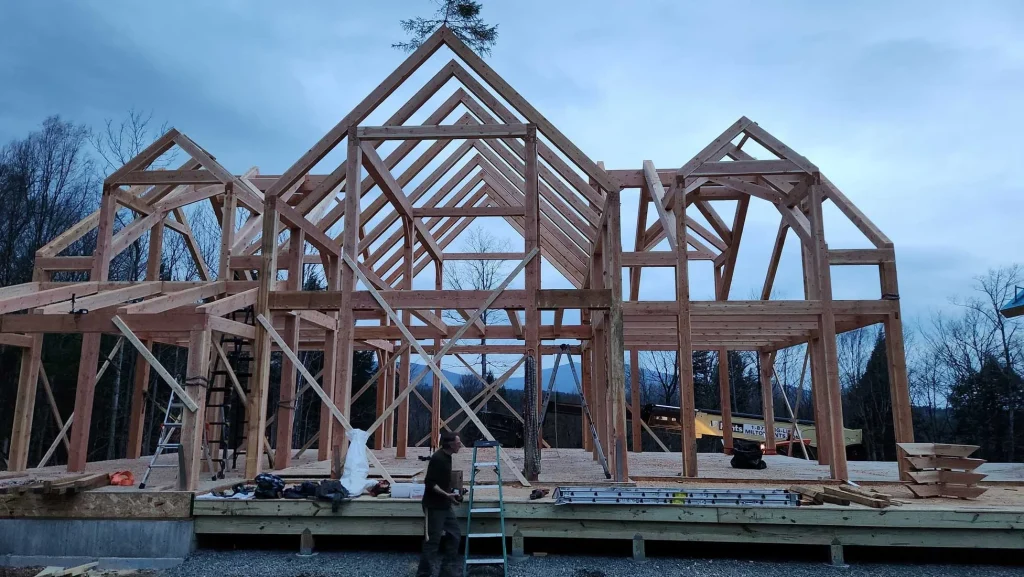
12 Questions to Ask a Timber Frame Company Before You Sign
By the time some folks call us, they’ve already talked to two or three other builders. Usually they have a folder of notes and some drawings. What they don’t have is an easy way to compare it all, because every company told them something a little different. When Bruce talks it through with them, most of it comes down to asking the right questions early.
So we wrote them down. They’re good sense for hiring any timber frame company.
- Who will actually cut my frame?
- How long have you been doing this?
- Can I talk to past clients?
- What kind of joinery do you use?
- Which species do you offer, and where does it come from?
- Do you sell stock plans, or design with me?
- What is included in the price?
- Why is your price higher or lower than others?
- Will I get a written proposal?
- Who raises the frame?
- Have you built in my state and climate?
- How will we stay in touch during the project?
A few of these deserve more than one line, so here’s how we think about them.
Who Is Holding the Chisel
Some outfits sell frames out of an office and send the cutting to a shop you’ll never see. Ask for names. Ask if you can talk to the person who will lay out your joinery. In our case that’s Bruce and his sons, Garrett and Chris.
How long they’ve been at it matters too, mostly for the odd moments. A roof where two valleys meet a purlin. A steep site. A late change from your architect. Our family has been cutting frames since 1979, and after that long most problems have shown up at least once before. Ask any company how many jobs like yours they’ve done, not just how many total.
And call the references. Don’t only ask if they were happy. Ask what went wrong and what the builder did about it. Every job has a hiccup somewhere. We’re glad to put you in touch with past clients if you ask.
Pegs or Plates
This one tells you what you’re buying. A traditional frame is held together with mortise and tenon joints and wooden pegs. Some builders lean on steel plates, bolts or hidden brackets. Metal isn’t always wrong, but you should know which one is in the quote.
All of our frames are cut by hand and pinned with oak pegs. There are no nails or plates holding the joints. When a tenon slides into its mortise and the peg is driven home, it draws the joint up tight, and that’s what keeps it there. We wrote more about it in our piece on mortise and tenon joinery.
On wood, ask what they’d recommend for your project and why. We cut eastern white pine, Douglas fir, hemlock and oak, all from sustainably managed forests. The softwoods are more common now and easier to work. Oak takes more effort, but it’s worth it when it fits. The curved knee braces on the Sequoyah came from oak trees we slabbed right in the woods and carried out one at a time.
Money and Paperwork
This is where budgets go sideways. One company’s number is just the frame. Another includes delivery and raising. A third throws in wall panels. Ask about design time, timber, finish, shipping, the crew and crane for raising day, and panels, one by one. Then ask what’s left out.
For us, the answer is simple. We design the frame with you and your designer, cut it in Alstead, and raise it. Foundations, plumbing, electrical and general contracting are done by others, so plan on a local builder for the rest.
A good company can explain its price in plain words. Ours stays competitive because we’re a small family crew with low overhead, and you deal straight with us. Before anything gets signed, we put together a written proposal and walk you through it. It should list the scope, the species and the design in language you can follow.
Raising Day and After
Ask who shows up when the trucks arrive, and how long they stay. Some companies drop a stack of timber in the driveway and wish your contractor luck. We raise our own frames, and we’ve shipped them a long way from New Hampshire. Loren’s frame was cut about 1,700 miles from his site and, in his words, went together “without one miss cut beam.” The crew stayed on to help with his SIPs, porch roof and ceilings.
Climate is worth a question too, since snow and wind change how a frame should be built. And ask how you’ll hear from them while your frame is being cut. Silence is the most common complaint people have about builders.
Write the answers down as you go. After a few calls, you’ll notice which company answers without hedging.
If you’d like to run through the whole list with us, get in touch or call (603) 309-8793 and we’ll talk it over.


